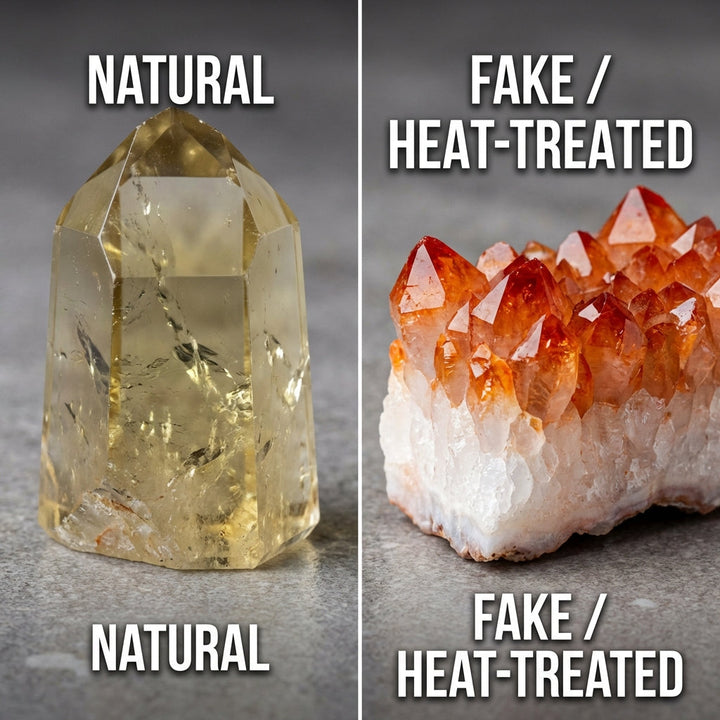
In the world of crystal healing and gemstone collecting, authenticity is everything. At GiftPalace 2026, we pride ourselves on sourcing only the finest natural specimens. Here is our expert guide.
1. The "Bubble Trouble" Test (Glass vs. Quartz)
One of the most common fakes is colored glass. The biggest giveaway? Air bubbles. Natural crystals almost never have perfectly round air bubbles. If you see tiny circles under a magnifying glass, you're looking at glass.

2. The Temperature Touch
Real gemstones always feel cold to the touch. Hold the crystal against your cheek. A natural stone will feel icy. Plastic or resin will feel warm almost immediately.
3. Spotting "Crispy" Citrine
Natural Citrine is a pale, uniform champagne yellow. Heat-treated Amethyst (often sold as "Citrine") has bright burnt orange tips and a white base

4. The Cracks in the Dye
Dyed Howlite often poses as Turquoise. Look at the cracks—if the blue color is concentrated or "bleeding" into the cracks, it is a fake.

5. Perfection is a Red Flag
Nature is beautifully imperfect. Authentic crystals have asymmetry, inclusions (tiny internal veils), and a natural weight that fakes cannot replicate.